
This didn’t start as serious scholarship. It started on a Sunday morning when I got stoned, opened Google Maps, and thought: okay, but where exactly did they hang H.H. Holmes under that Acme?
I live about a twenty minute walk from 1400 E. Passyunk. The plan was to walk over and look for myself. Then it started raining.
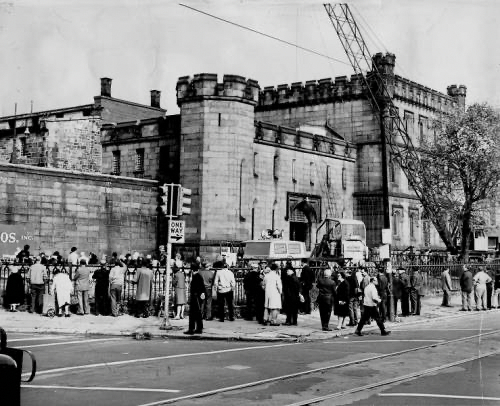
The first thing I noticed on the satellite view was the shape of the plot. It’s not a rectangle. It’s not a standard commercial footprint. It’s the exact outline of Moyamensing Prison, which operated on that block from 1835 until it was demolished in 1968. Philadelphia County Prison, if you want to be formal about it. Most people don’t. That might have been enough for most people. I’m neurodivergent, it was raining, and I had nowhere to be. I kept going.
I started digging. Where in the prison did executions happen? Was there a dedicated chamber, or a yard, or just a corner they used? Pennsylvania ended public executions in the late 1830s, which meant hangings moved inside prison walls. But inside meant different things in different prisons. Some had separate execution buildings. Some had dedicated death row blocks. Some, frankly, just had a rope and a convenient beam.
The internet was not particularly helpful on specifics. What I found ranged from ‘here at 10th and Reed, America’s first serial killer was hanged’ accompanied by a vague gesture at the entire grocery store, to a joking claim that he was hung at the deli counter. Since I hadn’t been inside that particular Acme before I had no idea what the layout of the store was, and the internet clearly wasn’t going to tell me. I needed to see the prison from above. Moyamensing was demolished in 1968, which is late enough for aerial photography to exist. I found a 1967 shot, overlaid it on the current satellite image, and traced the prison footprint onto the block. The cell blocks lined up almost exactly with the existing building.
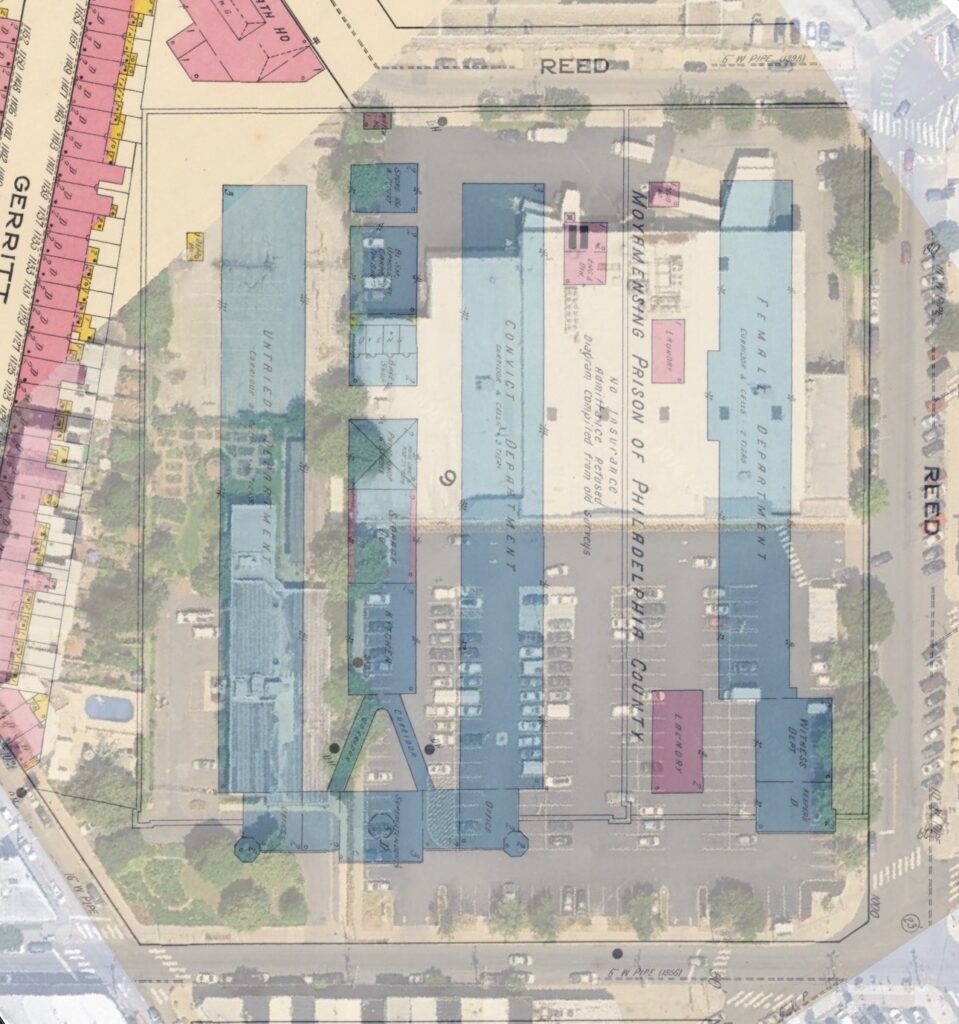
That’s when it got interesting.
The Acme occupies roughly one quarter of the original prison’s built footprint. The entrance and administration building sat at approximately the current parking lot entrance off Passyunk near Dickinson. Walking through the front doors of the grocery store today puts you about halfway down the center of the convict cell block.
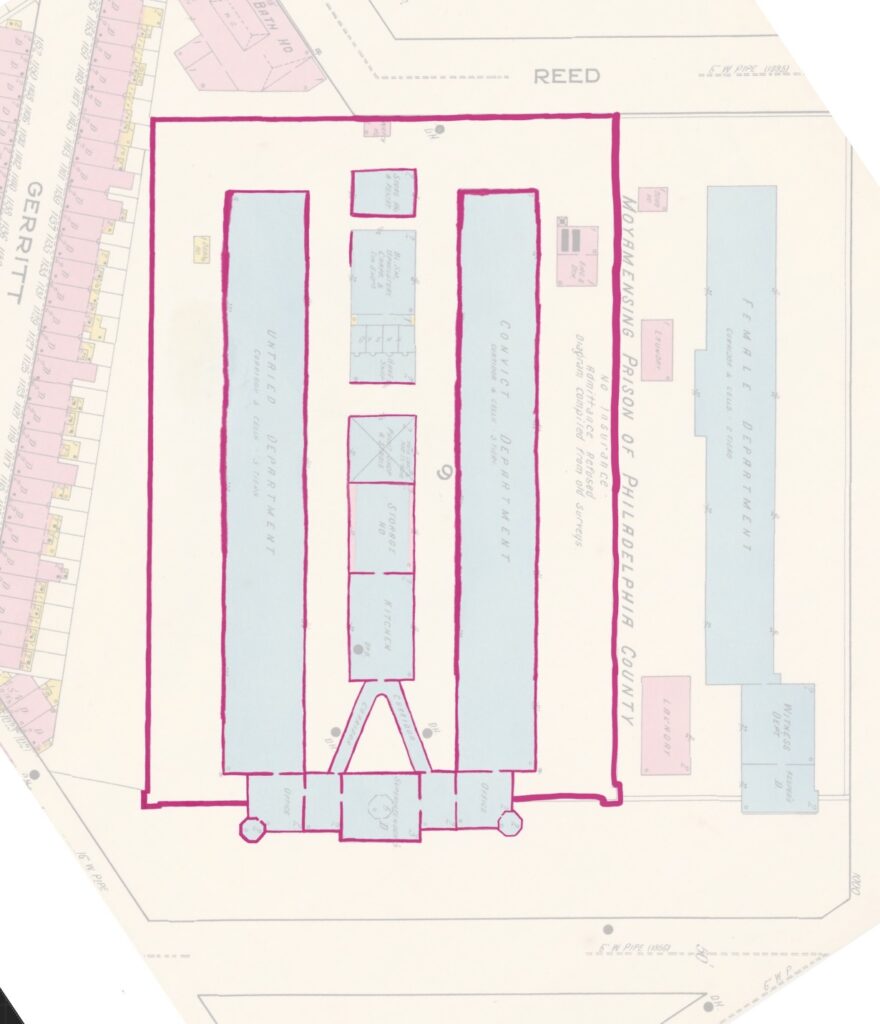
Moyamensing had three cell blocks: the female department, the untried department, and the convict department. The Sanborn map labels their arrangement: the untried department on the west, the convict department in the center, the female department along the 10th Street side to the east. For our purposes, we’re focused on the convict and untried blocks. The front of the complex housed the entrance and the superintendent’s office, with clerk offices at the head of each block. The design was deliberate: from those clerk positions, a guard had a sightline to every cell door.
When H.H. Holmes arrived at Moyamensing in 1895 he was placed in Cell 71 on the upper tier. At that point he hadn’t been convicted yet, which tells us something about where that cell was. Moyamensing’s two main blocks were divided by legal status: the untried department held people awaiting trial, the convict department held those already sentenced. In August 1895 Holmes was still untried, which places Cell 71 in the untried department.
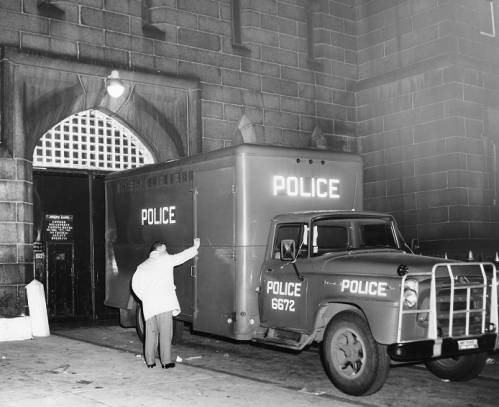
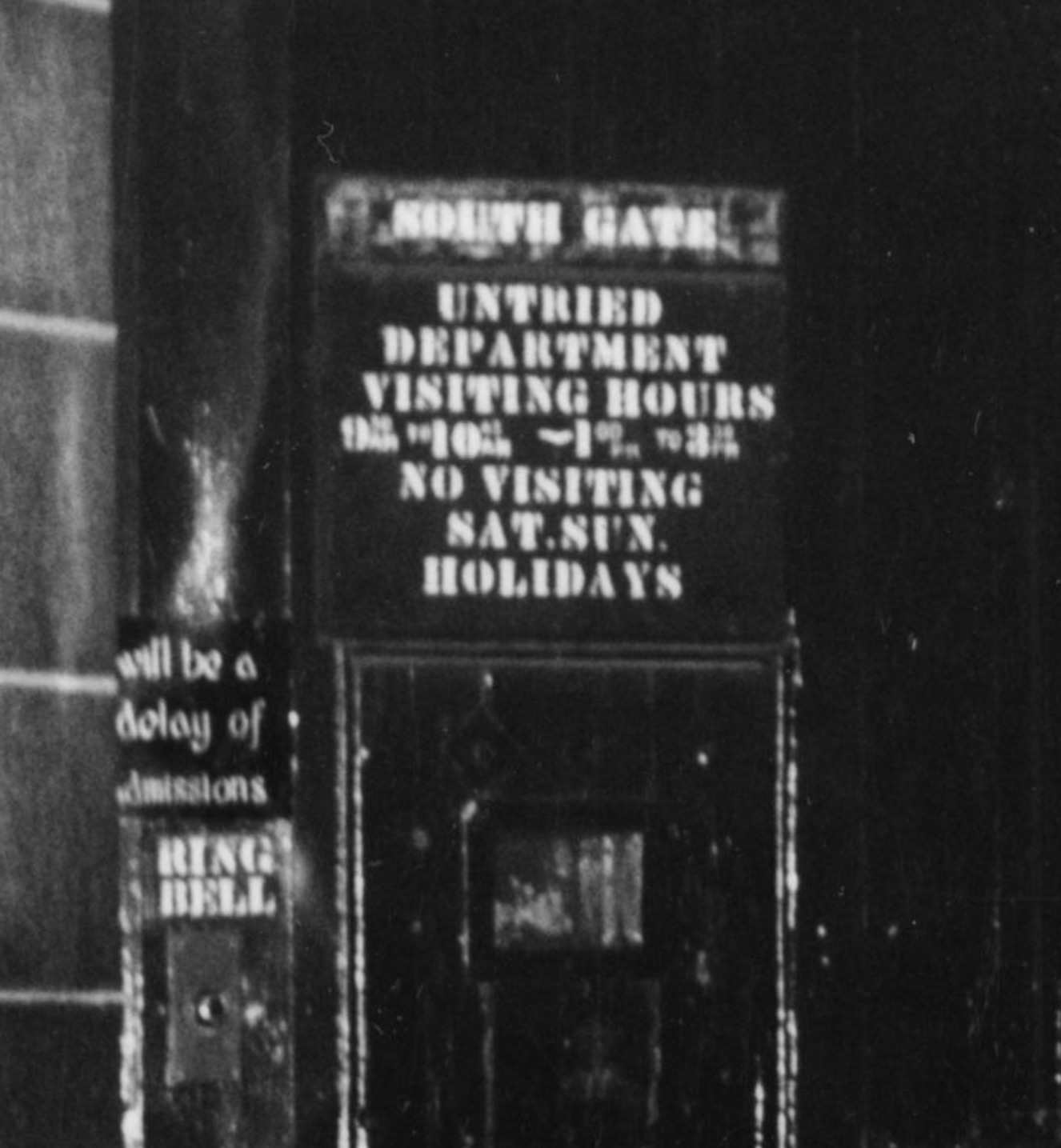
His own words corroborate it. In a September 1895 interview he noted his cell was “well located because from it I can see the prison vans loading and unloading their cargoes of unfortunates.” Photographs of the prison’s main entrance confirm that the gate at 11th and Passyunk served the untried department specifically. The words SOUTH GATE / UNTRIED DEPARTMENT were stenciled on the door. The prison’s internal compass put Passyunk to the south and Reed Street to the north. Cell 71, on the upper tier of the untried block, faced that entrance.
After the guilty verdict came in on Saturday November 1, 1895, Holmes was returned to Moyamensing and sent back to Cell 71. Three days later the Philadelphia Times confirmed he had not yet been moved: “The prisoner’s cell was not changed to the tier on the second floor known as Murderers’ Row, and he still occupies No. 71.” Within the month that changed. By December 2, 1895, the Inquirer reported that Holmes “now occupies a cell in what is known as Murderers’ Row, in the county prison.” He had been moved from the untried block to the convict department, to the second floor tier reserved for condemned men.
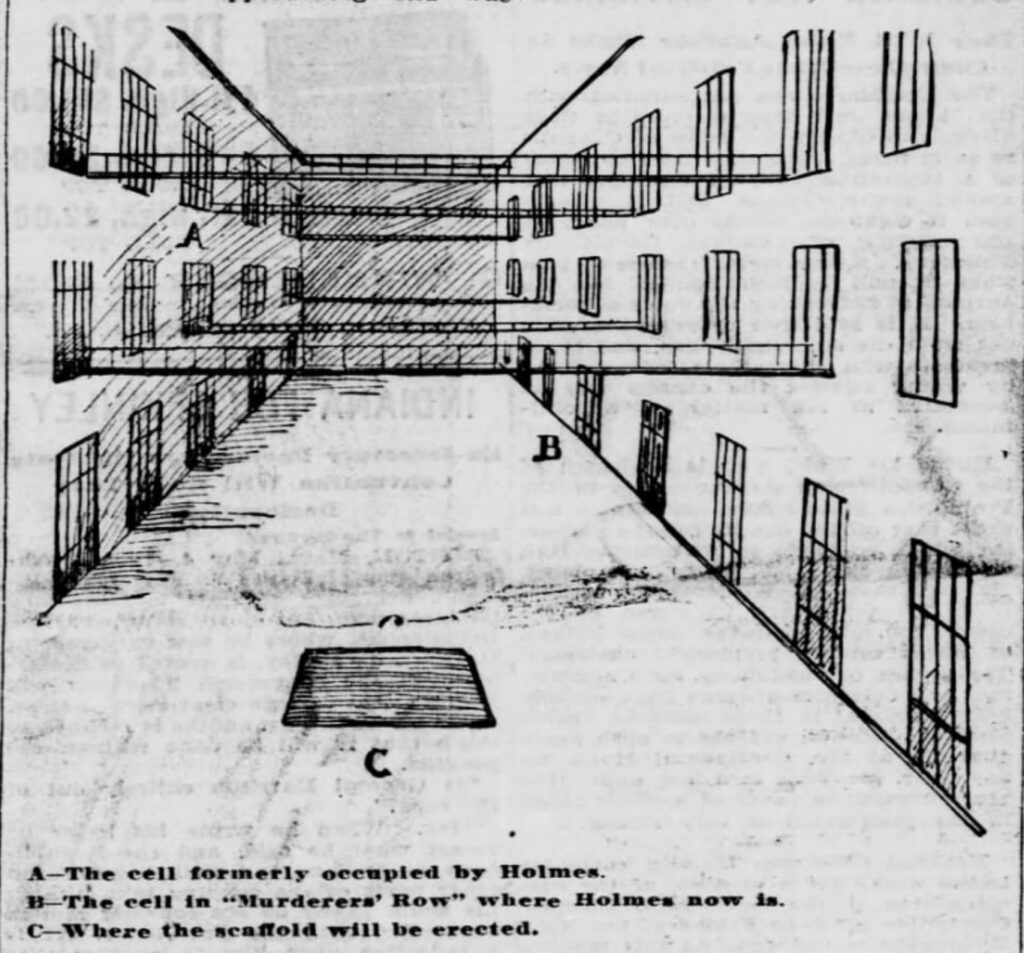
The diagram shows Cell B, Holmes’ new ground-floor cell, on one wall of the corridor, with scaffold platform C about thirty feet to the north. Two days before the execution, Assistant Superintendent Richardson entered Holmes’ cell at breakfast and told him he was being transferred to the ground floor. Holmes received the news “coolly,” asked if he could bring his books and papers, and was told they would follow. He walked the south balcony to the stairs, descended to the corridor floor, crossed to the far wall, and entered the new cell about midway along the corridor’s length. On the way he tried very hard to catch a peek at the gallows but “all evidences of its presence or of the spot where it is to stand had been removed.” He would not see it until he stepped from his cell door on execution morning.
One other detail worth noting: by the morning of the execution, Holmes had that entire section of the corridor to himself. Every other prisoner on that block had been removed. One of America’s most notorious murderers spent his last hours in a large section of Moyamensing with no neighbors, no noise from other cells, just the gallows thirty feet away.
Somewhere Near Seafood
The Inquirer placed it precisely the morning of the execution: “the north end of the east corridor of the convict department, not more than sixty feet from the entrance to Holmes’ cell.” North meant Reed Street. The prison called its Passyunk entrance the South Gate, which fixes the orientation: the far end of the corridor was the Reed Street end. Cross-referencing that with the building overlay put the scaffold in the back of the current store. A few days later I went to check.
The store runs roughly front to back along the same axis the cell blocks did. Walking in from the Passyunk side puts you at the south end of the convict block. The north end, where the gallows stood, is toward Reed Street, which is the back of the store. The east corridor, the row of cells on the 10th Street side of the block, runs left of center as you’re facing toward the back of the store.
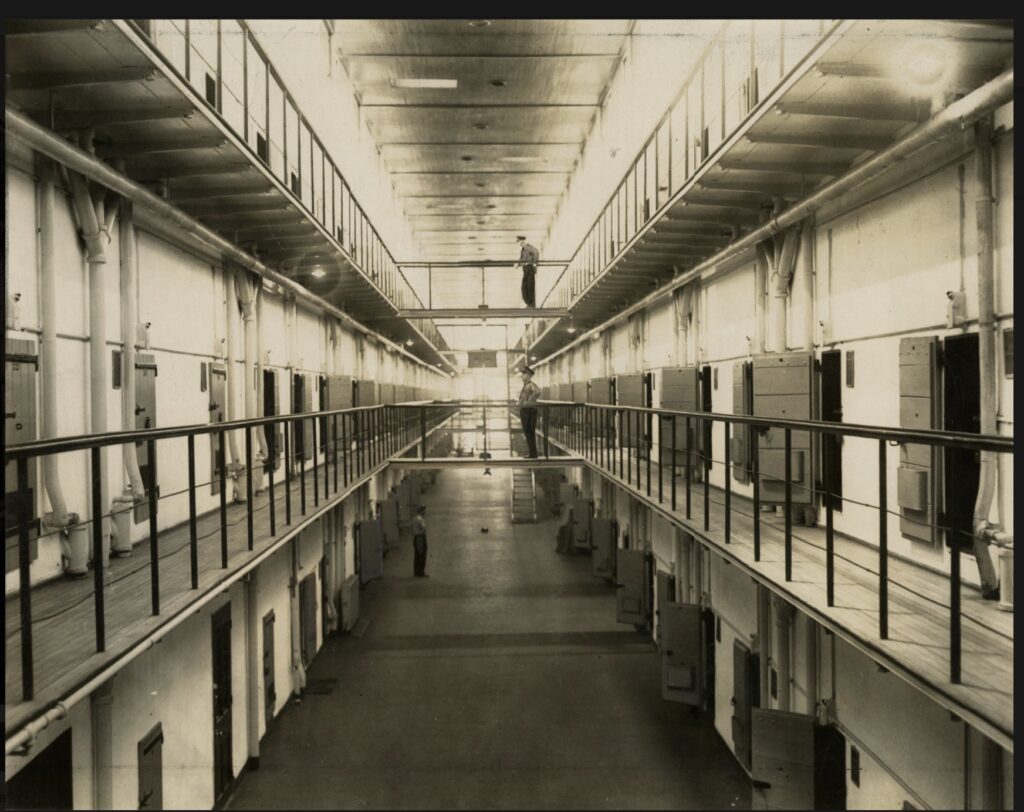
The photograph above, taken in 1932, appears to show the convict corridor looking north toward Reed Street – the same corridor, and possibly the same direction, as the procession on May 7, 1896.
The diagram published two days before the execution shows Holmes’ death cell and the scaffold clustered in the northern section of the corridor, not at opposite ends. Cell B is on the right side of the corridor. The May 5 article called the cell’s position midway along the corridor; the diagram itself and the morning-of report both place the pair closer to the Reed Street end. Where the sources disagree, I’m crediting the diagram and the more specific account. Scaffold C sits a short distance north of it on the corridor floor. The Inquirer confirmed the gap: not more than sixty feet from his cell door to the gallows.
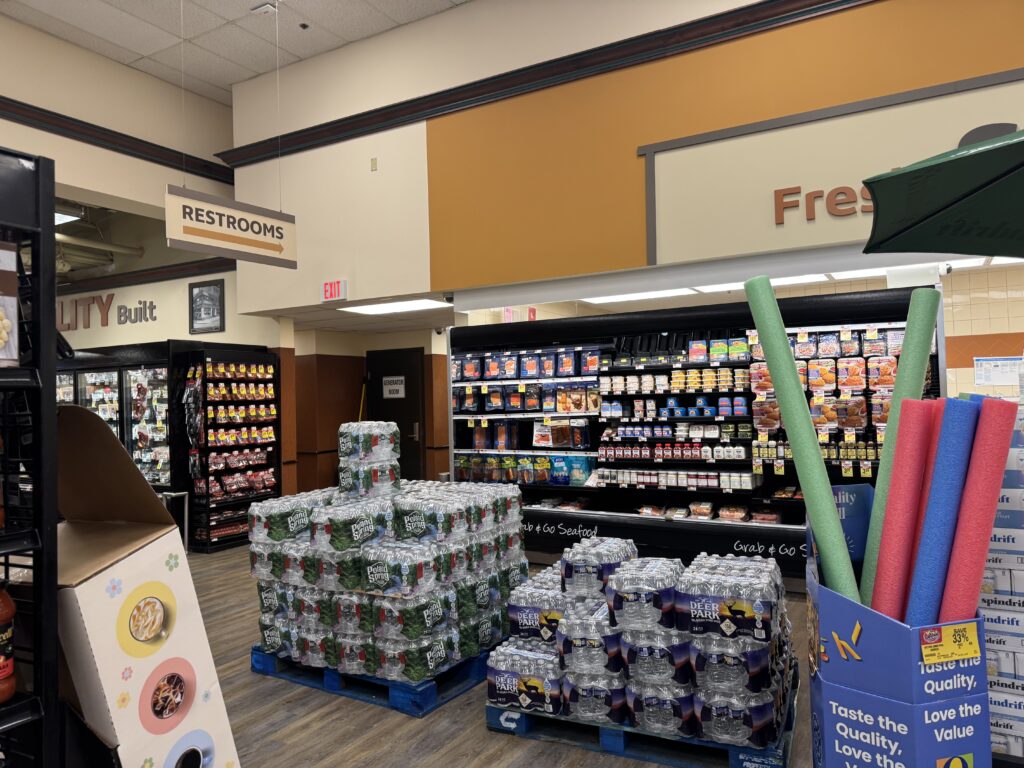
That puts both the death cell and the scaffold in the same back section. If you’ve been to this Acme, you know the spot: the area behind the main floor where the food cases give way to the seafood counter, right near where the generator room door is.
Thursday Morning
Holmes had been in the death cell since Tuesday. By execution morning, May 7, he was already there waiting.
Sheriff Clement had issued invitations to the execution: fifty-one by one account, sixty-one by another. It didn’t hold at either number. Prison inspectors used their official positions to bring in twenty-five or thirty personal friends, who mingled freely with the invited guests. By the time the morning of May 7 arrived, roughly twice the invited number were inside the gates. The sheriff was publicly indignant about it and said so. Whatever the final tally, more than a hundred people were packed into the northern end of that corridor.
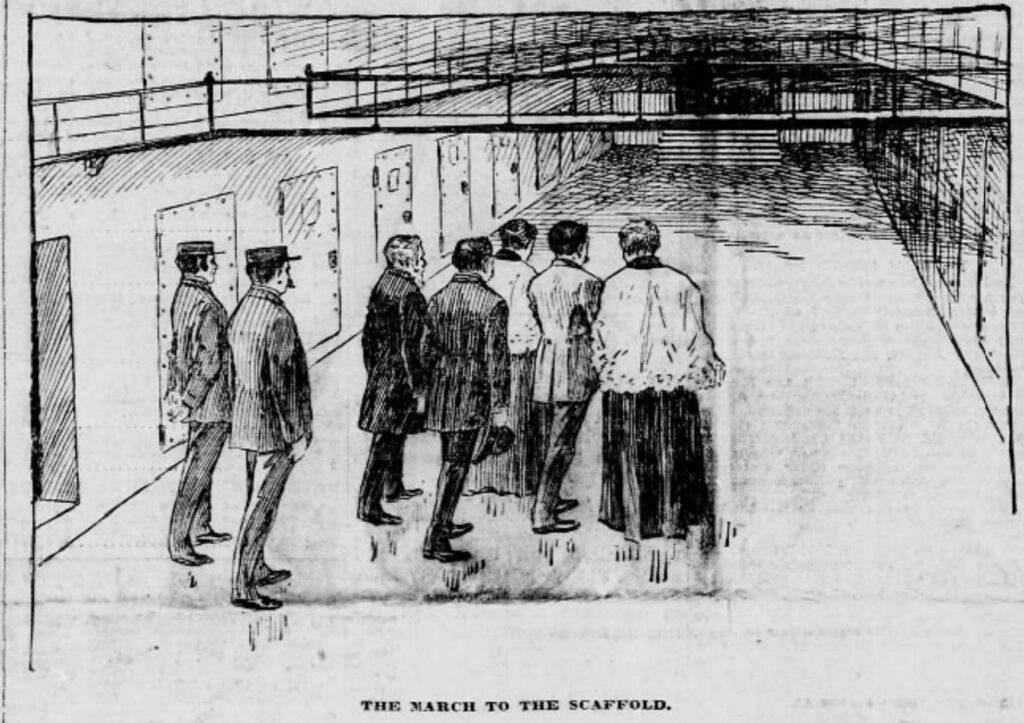
At 10 AM, the door from the prison office opened and the procession came out. Jurors first, then witnesses, stepping down to the asphalt corridor floor. Every wooden cell door in the long block was shut tight. Holmes was behind one of them and could hear the company as it marched by. The witnesses filed through the door built into the scaffold and turned to face the platform. The door was closed behind them so they could not watch him approach.
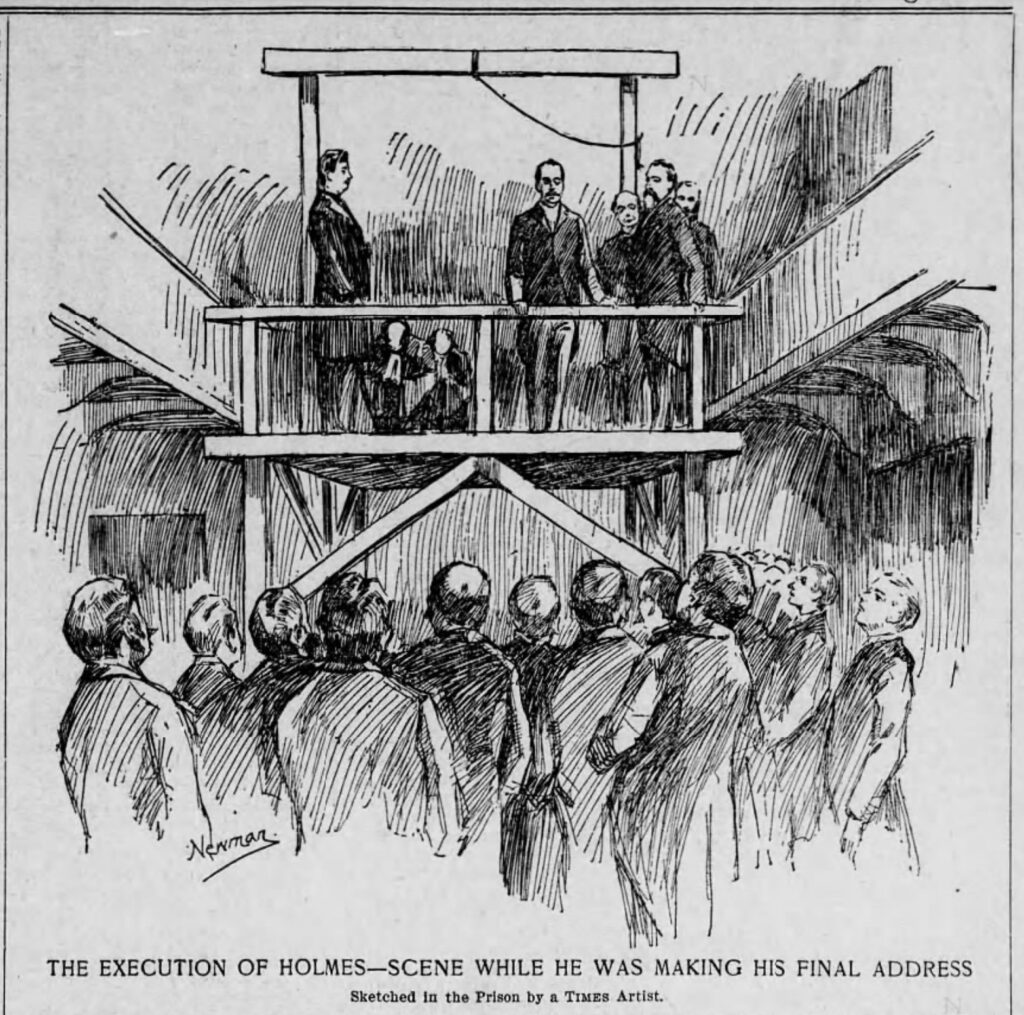
A minute’s silence. Then the low chanting of the priests, growing louder. Footsteps on the wooden stairs. He climbed thirteen steps holding a crucifix, walked to the rail at the edge of the platform, and rested his hands on it as comfortably, the Inquirer noted, as if he were a spectator and the rest of the party a show.
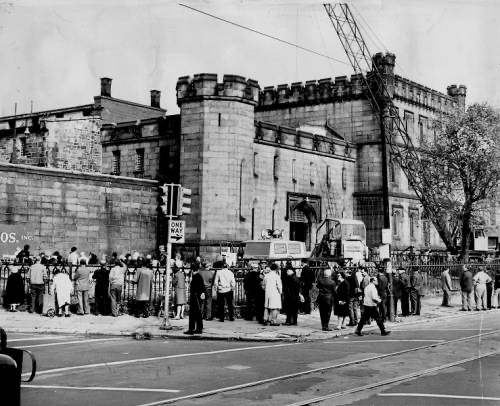
The South Gate is a garden now. The Gothic entrance building came down in 1968 along with everything else, but parts of the perimeter wall didn’t. Along the parking lot side, the original prison stonework is still standing. It’s now reduced to a low base, topped with chain link instead of its original height, graffiti on the patched sections, trees grown up against it. The same rough-cut stone that appears in every photograph of the prison. It’s been there since 1835.
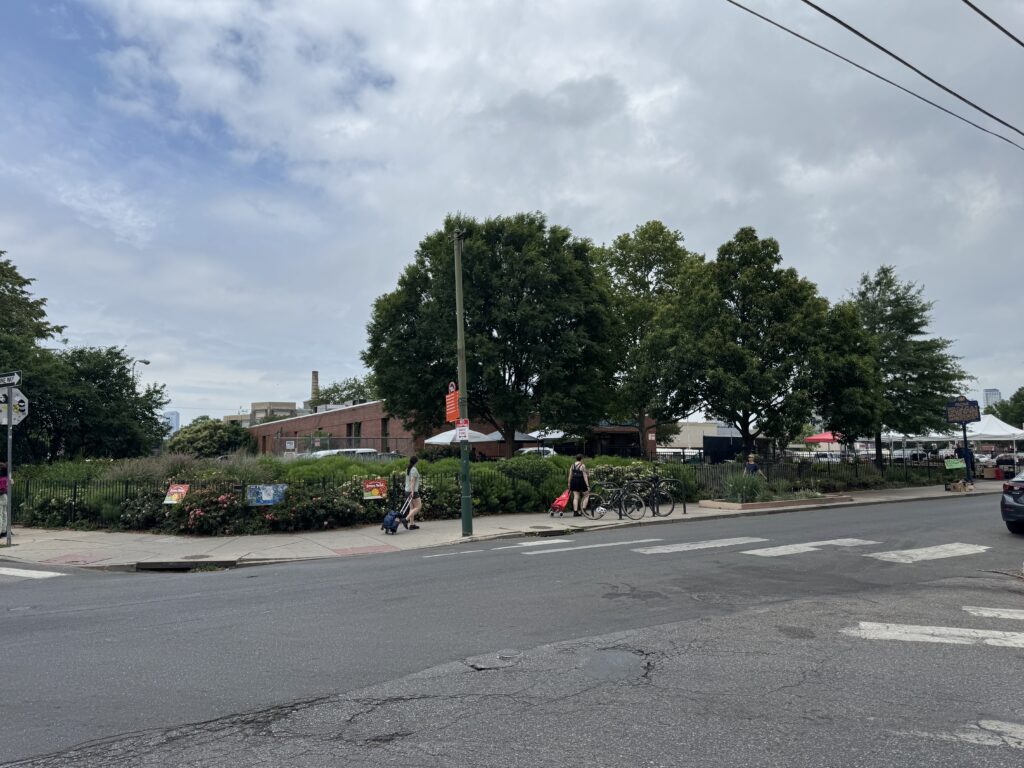
The Reed Street side looks like the back of a grocery store. Loading dock, dumpsters, painted block wall. Nothing from the 1897 photographs remains visible there.
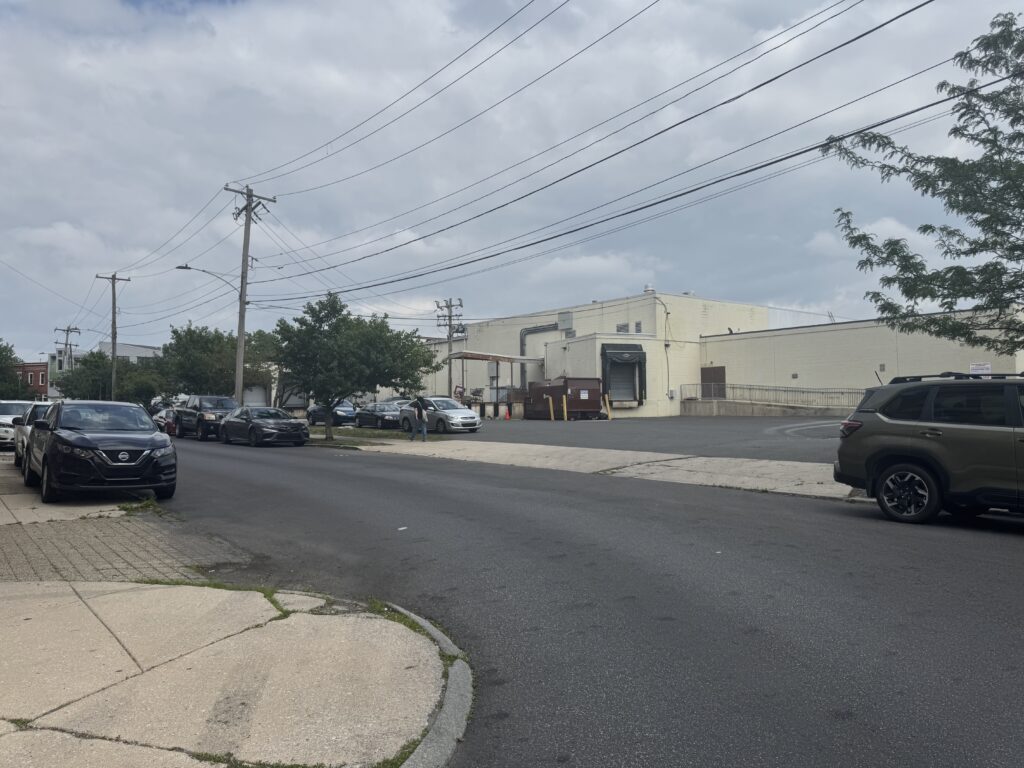
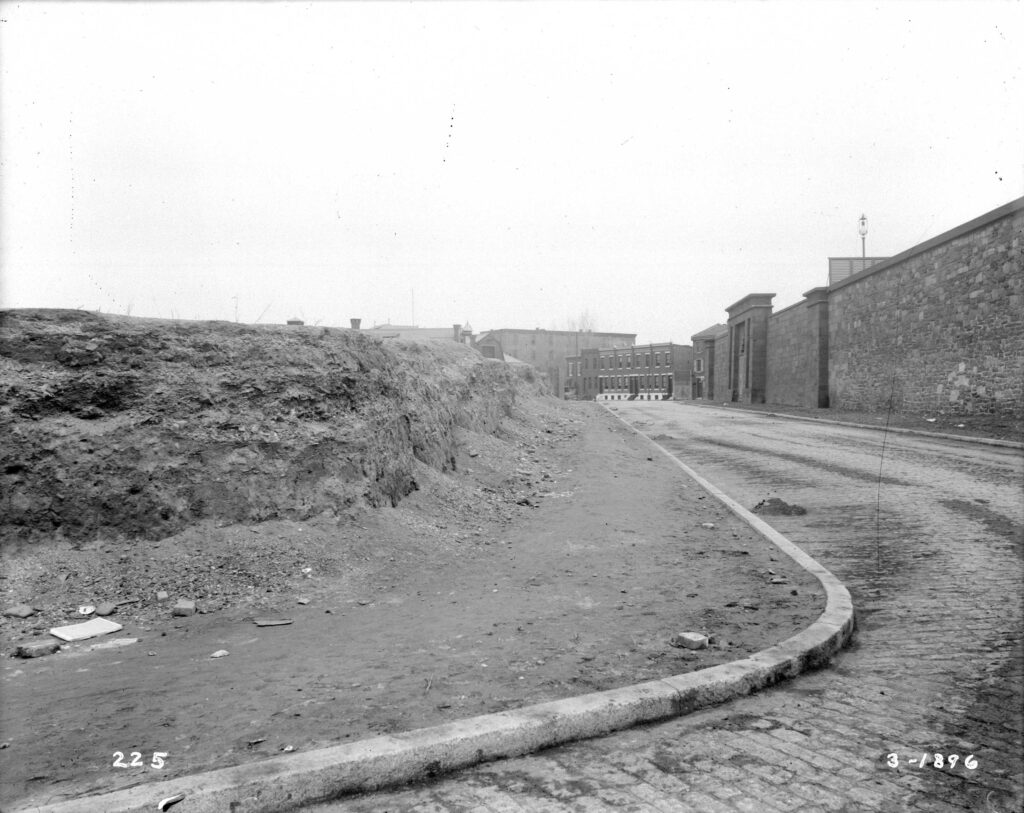
You go in from Passyunk. Walking through the front doors puts you at the south end of what was the convict corridor. The store runs back toward Reed Street along the same axis the cell block did. Past the registers, past the produce, past the main aisles.
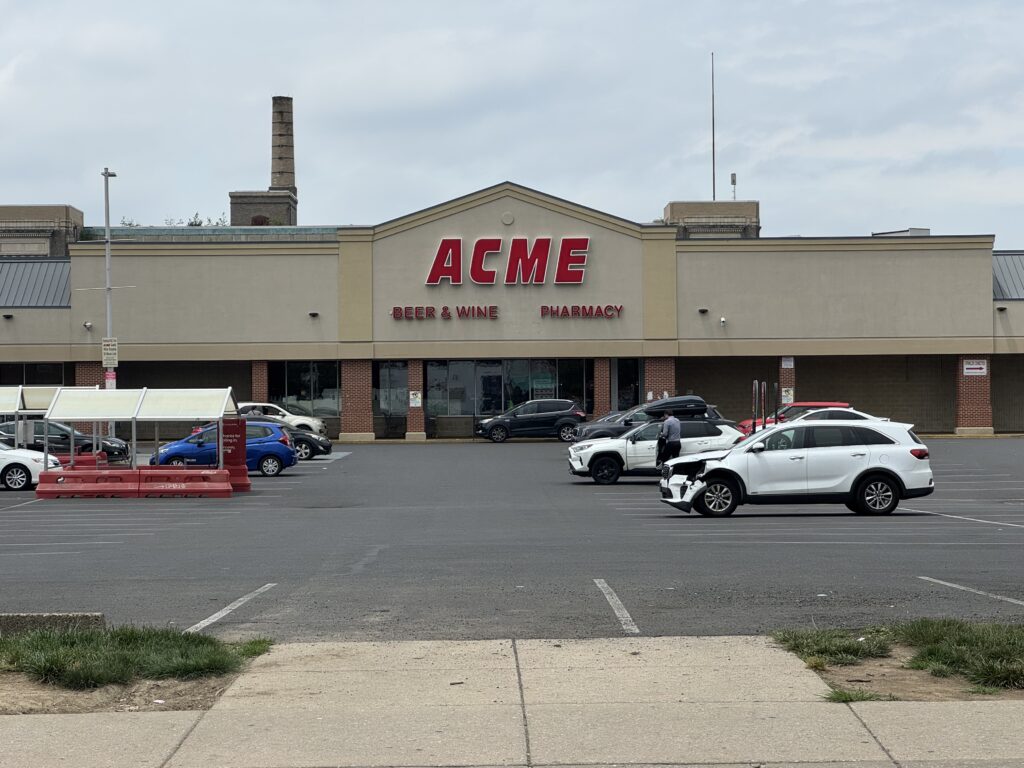
It’s fluorescent and it smells like a grocery store. The Inquirer described that section of the corridor as secure from observation to all except those on the floor. The people in line at the seafood counter qualify.
The trap dropped at exactly 10:13.