

The Legend
The story goes that if you stand before her at midnight under a full moon and say “Weep, woman, weep,” the statue will cry. Some say she weeps only on the anniversaries of her children’s deaths. Others say only when the moon is right. Visitors over the years have reported streaks running down her face, as though the stone itself holds something it can’t keep in.
The legend has been mutating for at least a century. By 1969, a version circulating among Utah State University students had transformed Olif into a villain: a cruel husband who cursed his family on his deathbed, promising that every six months the eldest child would die, and that once all the children were gone, the mother would follow. The family didn’t believe him until it started happening. In this version, the grief belongs to the children’s deaths but the cause belongs to a man’s malice. The real story inverts that completely.
By 1979, the legend had shed its narrative entirely. A version popular with USU students at the time held that if you drove to the cemetery at night and shone your headlights on the statue, she would jump down from the stone and run. Shine them again and she’d go back. The grief had become a parlor trick.
That’s how folklore works. It simplifies, it dramatizes, it assigns blame, and eventually it forgets the person entirely. What’s left is the stone woman and the story people needed her to tell.
Her name was Julia Amelia Christiansen Cronquist. She went by Amelia. The monument doesn’t say that. It says Cronquist, nothing more. That’s part of how legends form and women disappear.
Weeping Women
Amelia’s legend didn’t emerge from nowhere. It stepped into a tradition thousands of years old.
The weeping woman is one of the most persistent figures in human mythology, and she’s almost always a mother. Niobe, in Greek mythology, boasted that her fourteen children made her superior to the goddess Leto, who had only two. Leto’s children were Apollo and Artemis. They killed all fourteen of Niobe’s. Niobe wept so ceaselessly that the gods turned her to stone, still weeping, forever. The prophet Jeremiah wrote of Rachel weeping for her children, refusing to be comforted because they were gone. Matthew invoked the same image for the slaughter of the innocents. La Llorona, the most enduring weeping woman legend in the Americas, is a mother who drowned her own children in a fit of anguish and now haunts rivers and roadsides wailing for them, a figure so widespread across Latin American cultures that her origins are genuinely untraceable.

The banshee of Irish tradition is a wailing woman whose cry doesn’t cause death but announces it. The Morrigan appears on battlefields as a weeping washer-woman, cleaning the shrouds of those about to die. Across cultures and centuries, when grief needed a face, it was given a woman’s face.
This was not accidental. In most patriarchal societies, women were culturally assigned as the primary performers of grief. They were expected to wail, to keen, to sit with the dead, to mourn visibly and at length. Men were expected to endure. So grief became feminized, not because women feel more than men, but because women were required to show it. The weeping woman became shorthand for grief itself, not just a grieving person but sorrow as a permanent, embodied force.
Victorian and Edwardian cemetery sculpture understood this completely. Weeping women, draped mourning figures, grief personified in stone: these were standard vocabulary for memorial monuments of the era. They were meant to make loss visible and permanent, to mark a place where something irreplaceable had been and was gone. Cemeteries across the United States are populated with them.
And legends accumulate on them, almost inevitably. A weeping woman in a liminal space, with a genuinely tragic history, in stone that weathers in ways that look like tears: the folklore writes itself. Visitors project. Communities remember selectively. Details drift. By the time the story becomes “she wept herself to death,” it isn’t entirely wrong. It’s just collapsed something long and complicated into something the human heart can hold more easily.
Logan Cemetery has its weeping woman. So does Fish Creek, Wisconsin. The Black Angel of Iowa City has accumulated decades of legend. The various statues known collectively as Black Aggie have spawned stories across the country. The pattern is consistent: striking figure, tragic history, liminal setting, stone that changes with weather and light.
Amelia Cronquist’s legend followed the pattern. What makes her different is how much of the real story survived.
Who She Was
Amelia was born Julia Amelia Christiansen on February 8, 1859, in Roskø, Denmark. In 1872, at thirteen, she crossed the Atlantic with her brother H.J. Christiansen, who would go on to edit Bikuben, a Danish-language newspaper in Salt Lake City. They were the first of their family to make the crossing.
She spent about a year in Salt Lake City before moving north to Cache Valley. On January 22, 1880, she married Olif Cronquist in the Salt Lake endowment house. They lived in the city for six years before moving to North Logan in 1886, where they built what the papers later called “a fine home.”

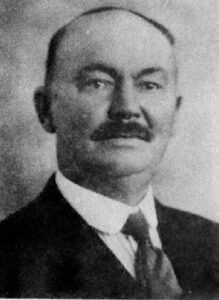
Olif Cronquist
Olif’s name appears in the historical record as Olif, Olof, Oluf, and Olaf depending on who was writing it down, but his presence in Cache County is consistent throughout. He homesteaded land in 1891, served as trustee of the Logan and Richmond Irrigating District, ran for constable as a Democrat in 1896, and eventually became chairman of the board of county commissioners. The local press called him one of the model farmers of the county. He built a two-story brick home valued at $2,600 and later installed 2,400 feet of galvanized pipe for a private water system, the best money could buy.
Life on the farm was not gentle. In the summer of 1897, pleuro-pneumonia swept through the county and killed sixteen of his cows. That same summer, thieves worked through the property for months, taking tools, hay, anything portable, and on multiple occasions frightened Amelia and the children while Olif was away from home. He told the paper he would give the thieves a warm reception if they returned. In 1897 Utah, that meant what it sounds like.
The Logan Republican would later describe him as “one of those hardy, rugged types that has done much to make this county what it is today,” a man who had stood by his wife “through sunshine and shadow, through poverty and prosperity.” The public record bears that out.
Five Children
Eight children were born to Amelia and Olif between 1880 and 1899. Five of them would die before Amelia did.
Margaret came first, in 1880. Then Olif Edward in 1883, and Emeal Oliver in 1885, two boys born two years apart. In early 1889, scarlet fever moved through the house. Both boys died. Olif Edward was five. Emeal Oliver was three. The disease left Amelia with lasting damage to her heart.
Orson was born in 1888 and survived. Elam arrived in 1891. In February 1894, Orson fractured his skull in a sledding accident. He recovered. That same year, Amelia gave birth to a daughter, Lilean, who died in infancy. Then Emelia, in 1895. Then Inez, in 1899.
By the spring of 1901, six of the eight children were still living. Then scarlet fever came back.
March 1901
The first of the two girls died on March 1, 1901. The Logan Journal reported it the next morning: a daughter of Olif Cronquist had died of scarlet fever. Mrs. Cronquist was very ill. Several members of the family were down.
The house was under quarantine. No one could enter or leave. The girls’ bodies remained in the home while the sick family lived around them. When the time came, Olif buried them in the night.
Emelia and Inez were buried together in a specially built casket. Their funeral was held at the cemetery on Sunday. The casket was placed over the grave and the lid removed for a final viewing. The Logan Journal described what mourners saw: the two girls lay side by side, fair as angels, half facing each other, in a beautiful, specially built casket, as though still mid-conversation, cold in death’s embrace.
One of the speakers that day was Elder H.J. Christiansen. Amelia’s brother. He told those gathered that he had stood at this same grave twelve years before, for this same family, when it was two boys. Now it was two girls.
Amelia was feared not to survive the funeral. Three weeks later the Journal reported her in critical condition, attributing it directly to the sickness and death of her children.
What Grief Does to a Body
Amelia did not die of a broken heart in any metaphorical sense. Her death certificate lists valvular disease of twenty years’ duration, with contributory rheumatism. Rheumatic heart disease follows streptococcal infections like scarlet fever. The damage began in 1889, when the boys died and Amelia survived the outbreak that killed them. She carried it for the rest of her life.
By 1913 the papers were noting she had been ailing for “some years past.” In March of that year she nearly died. She rallied, and survived another ten months.
In the final three weeks of her life, Amelia was confined to her bed. Olif kept vigil at her bedside. He was, the Logan Republican reported, “almost worn out” by the time the end came. Her physician attended her from January 1 to January 8. He last saw her alive on January 7. On the morning of January 8, 1914, Amelia died peacefully in her sleep. She was 54 years old, eleven days short of her 55th birthday.
Her obituary read: “A splendid type of woman, tender, loving, patient and true, bearing her great burden without complaint and always seeking the happiness and comfort of those about her.”
We have one other record of who she was in life. In 1904, a letter writer described stopping at Greenville and asking directions from “a kind looking Danish lady named Cronquist.” She sent him straight into mud so deep it swallowed a surveyor. Her directions: “You go straight on and you bet you fine out.”
That was Amelia.
The Funeral
Amelia’s funeral was moved from the North Logan meetinghouse to the Logan Tabernacle because more people wanted to attend than the smaller building could hold. County and city officials came as a body. The casket was covered in heaps of blossoms.
Sheriff N.W. Crookston, who had known Amelia since 1873 and served as her bishop for twenty-five years, spoke of the trials and hardships she had borne raising her family. President Joseph Quinney Jr. told the mourners that many good things had been said of this good woman, “but I venture to say that not half of the good she has stood for has been told.”
H.J. Christiansen spoke last. He had crossed the Atlantic with Amelia in 1872. He had stood at the grave of her children in 1889, and again in 1901. Now he stood at hers.
A week later, Olif Cronquist and Family placed a card of thanks in the paper.

The Monument
Three years after Amelia’s death, Olif commissioned the monument. The Logan Republican reported its installation in August 1917, calling it one of the largest and finest in the whole cemetery. It is Barre granite with a Westerly statue, the carving described at the time as “nothing short of beautiful.” The contract was executed by Elias Morris and Sons of Salt Lake City. The wreath in her hand, the quality of the stone, the scale of it: nothing about it was accidental or rushed. Olif took his time and chose well.
Today she stands in Logan City Cemetery at 1000 N 1200 East in Logan, Utah. The family’s plot is at A_100_45_4.
If you go, you’re looking for the woman with her head in her hand. You’ll recognize her. She has been standing there for over a century, and she has not run out of reasons to grieve.

Sources
Newspapers
- “Notice for Publication.” The Journal (Logan, UT), January 28, 1891, p. 8.
- “Notice for Publication.” The Journal (Logan, UT), February 4, 1891, p. 2.
- “Died.” The Journal (Logan, UT), February 14, 1891, p. 4.
- “The County Court.” The Journal (Logan, UT), 1892. [Double assessment abatement list.]
- “New Buildings.” The Salt Lake Tribune, January 1, 1893, p. 10.
- “Notice.” The Journal (Logan, UT), November 25, 1893, p. 8.
- “Logan Democratic Primary.” The Journal (Logan, UT), May 30, 1894, p. 5.
- “Oluf Cronquist of Greenville…” The Journal (Logan, UT), May 23, 1894, p. 8.
- “Logan Democratic Primary.” The Journal (Logan, UT), November 3, 1896. [Constable candidate listing.]
- “Pleuro-Pneumonia Among Cattle.” The Journal (Logan, UT), October 23, 1897, p. 8.
- “Thieves at Cronquist Farm.” The Journal (Logan, UT), November 27, 1897, p. 8.
- “A Bitter Dispute.” The Journal (Logan, UT), July 31, 1902, p. 1.
- “Olif Cronquist, Systematic Farming.” The Logan Republican, March 24, 1903, p. 8.
- “Our County Roads.” The Journal (Logan, UT), April 5, 1904, p. 2.
- “Unfortunate Woman Becomes Insane.” Deseret Evening News, March 2, 1901, p. 7.
- “Death from Scarlet Fever.” The Journal (Logan, UT), March 2, 1901, p. 8.
- “Touching Scene.” The Journal (Logan, UT), March 7, 1901.
- “Mrs. Olof Cronquist is Very Ill.” The Journal (Logan, UT), March 28, 1901, p. 8.
- “Mrs. Olof Cronquist Quite Sick.” The Journal (Logan, UT), March 1, 1913, p. 5.
- “Mrs. Olof Cronquist Very Ill.” The Journal (Logan, UT), March 13, 1913, p. 8.
- “Wife of Commissioner Cronquist is Dead.” Deseret Evening News, January 9, 1914.
- “Mrs. Amelia Cronquist.” The Journal (Logan, UT), January 10, 1914, p. 1.
- “Death Calls Mrs. Cronquist.” The Logan Republican, January 10, 1914.
- “Our Sympathy.” The Logan Republican, January 10, 1914.
- “Funeral of Mrs. Cronquist.” Deseret Evening News, January 10, 1914.
- “County Officials to Attend Funeral.” The Logan Republican, January 10, 1914, p. 5.
- “Funeral Services Held in Logan Tabernacle.” The Logan Republican, January 13, 1914, p. 1.
- “Cronquist Funeral.” Ogden Standard-Examiner, January 12, 1914, p. 8.
- “Card of Thanks.” The Logan Republican, January 15, 1914, p. 1.
- “Cronquist Has Large Monument Erected on Lot.” The Logan Republican, August 9, 1917, p. 1.
- “Accident Near Logan Fatal to One as Car Hits Ditch.” The Salt Lake Tribune, August 29, 1948.
- Johnson, Jack. “Weeping Lady Legend Put to Rest.” The Utah Statesman, October 24, 2022.
Records
- Julia A. Cronquist, Death Certificate, State of Utah, January 8, 1914. Cache County, File No. 4[partial]. Informant: Olif Cronquist.
5 comments
The house that this family lived in was my parents first home and is still owned by close family members.
That's really cool….that house has a LOT of history! 🙂
What’s the chances 5 of your kids die of Scarlett’s fever and also the mother too, of a very rare disease it’s pretty sad
That is so very heart braking for a mother & father to lose 5 of their 8 children. I don’t know if i could stand the pain, having 5 of my children passing before me. What a tragedy for this family back in those days. The home has so much history, that it would be interesting to find out more information about their lives in the home which they lived in. And if it is still standing today.
[…] these legends are widespread, documented evidence to support them is rare. In many cases, the stories evolve from […]